Hospital trusts + ICSs
Multi-committee governance with explicit delegation cascades, chair rotation, and obligation tracking across clinical, financial, and operational portfolios.
01.3 — Quorum
Quorum is the system of record for institutional governance. Schemes of delegation, decisions, minutes, obligation calendars, authority-scope enforcement — built so a new chair inherits institutional context, not a folder of PDFs. Tenancy is institutional-identity (Person, Role, Committee, Membership), not flat workspaces.
A — Who Quorum is for
Quorum is calibrated for organisations that run governance through named committees — where decisions are bound by Terms of Reference, where authority is delegated explicitly, and where the next chair has to be able to pick up where the last one left off.
Multi-committee governance with explicit delegation cascades, chair rotation, and obligation tracking across clinical, financial, and operational portfolios.
PCN-level or federation-level governance over multiple constituent practices, with delegated authority and shared committee structures.
Time-bounded governance arrangements with formal delegation, scheduled obligations, and ratifiable decisions across stakeholder groups.
B — How it works
Quorum is organised around the four things every committee governance system has to get right: who exists institutionally, what they can decide, how those facts persist across time, and how obligations get discharged. Each pillar maps to specific surfaces.
01
Persons, Roles, and Role-Holdings — institutional identity, distinct from system identity. The person who is the Medical Director is recorded as the same person across every committee they sit on, and across every time-bounded role they have held.
02
Schemes of Delegation declare who can decide what. Committees have Terms of Reference. Outcomes that cite SE-entries are scope-checked at the point of binding — authority can be exercised, not asserted.
03
Memberships are time-bounded. End events name the doctrinally distinct reasons a Membership ends. Closed Memberships persist; the next chair sees the history, not a clean slate.
04
Obligations are registered against committees with target windows; forward projection sorts by deadline; overdue is computed mechanically. Discharge requires the outcome, not a checkbox.
C — Modules
Each module corresponds to a load-bearing governance primitive. The append-only chronology underneath every module is the institutional memory — closed memberships persist, superseded minutes are visible, deleted obligations never were.
Top-level committees and sub-committees, with Terms of Reference and approval flow.
Institutional identity register: Persons, Roles, and time-bounded Role-Holdings.
Persons bound to Committees in declared Membership Types for an effective period.
Structured delegations from source bodies to recipients, with limits, reservations, sub-delegation terms.
Per-meeting flow: agenda → items → quorum state → outcomes → minutes → approval.
Named decisions citing the source-of-authority Scheme entry; binding outcomes scope-checked at commit.
Approved minutes supersede prior versions; the approval event is the binding point, not the document.
Forward-projected obligation calendar with overdue computation and discharge tracking.
D — What Quorum shows
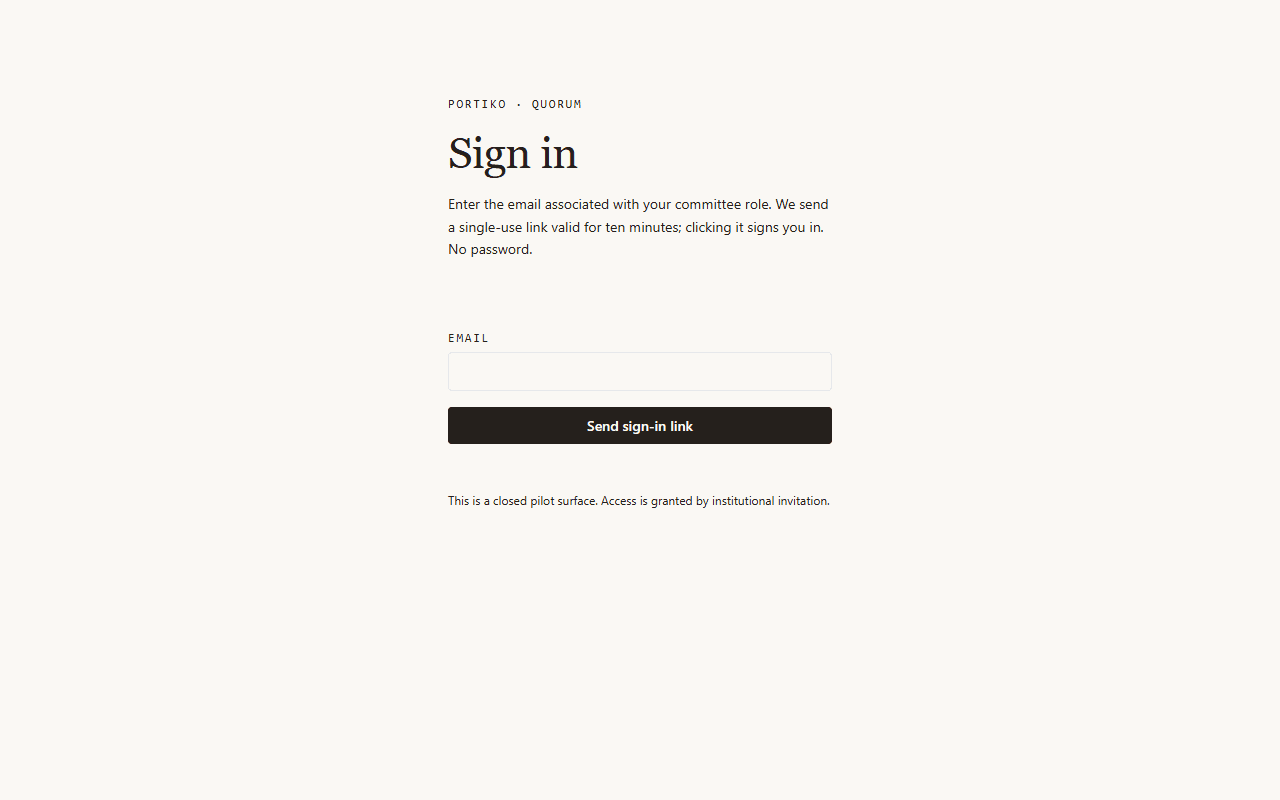
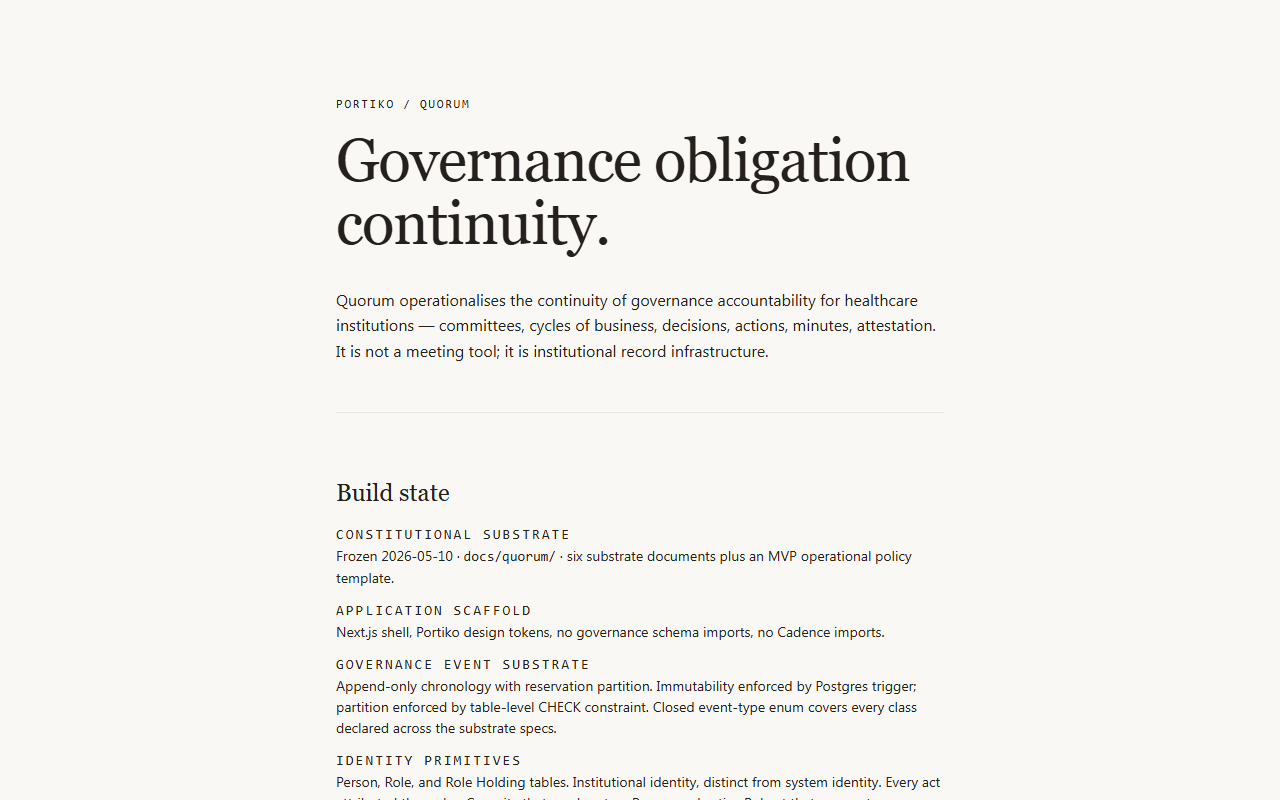
Captured against the running Quorum app, against the same code pilot partners sign in to. The sign-in surface is the closed-pilot gate; the landing surface declares the substance — governance obligation continuity for healthcare institutions.
E — Honest notes
It does not run calendars, send invites, or replace whatever scheduling tool your committees already use. It records the institutional consequences of those meetings — decisions, minutes, outcomes, obligations.
Minutes are authored by named secretaries. Quorum tracks the approval point, the supersession chain, and the binding-outcome citations — but the substance is yours.
Outcomes that cite an SE-entry are scope-checked at commit. If the cited Scheme entry does not authorise the binding outcome, the commit refuses. Authority is exercised, not asserted.
Engineering-verified (482 tests passing); not yet partner-deployed. Pilot-track access is by application.
F — Access
Quorum — pilot access
By application
Pricing follows pilot validation.
G — Common questions