01.2 — Relay

Daily clinical workflow,
as one operational app.

Relay is Portiko's daily-operations app for UK GP practices. Pathology, referrals, safety-nets, medication changes, recalls, and tasks captured in a unified inbox — each action audit-logged in the same database transaction that changes the operational state.

Status
Preview
For
UK GP practice teams
Capture flows
Six, integrated
Pricing
TBD

A — Who Relay is for

Built for the desk where the day's operational queues land.

Relay is calibrated for the people who handle the queues — pathology batches, referral letters, safety-net follow-ups — alongside whatever clinical system the practice runs. It is not a clinical record; it is the operational layer that sits next to it.

GP practice managers

Pathology batches, referral letters, safety-net chases, recall cycles, and general tasks — surfaced as one queue across all owners, with the audit trail attached.

Clinical leads

Visibility into what's slipping (overdue safety-nets, SLA-breached referrals, unactioned high-priority pathology) without having to ask three people. Reports that surface coverage gaps rather than headline counts.

Senior reception / admin

Structured capture for the operational work that historically lived in shared inboxes and spreadsheets — with provenance back to the originating record so nothing is orphaned.

B — How it works

Four pillars: capture, triage, action, report.

Relay is organised around the daily work — capturing operational state, triaging by what's about to slip, acting with audit-bearing certainty, and reporting on coverage rather than activity. Each pillar maps to specific surfaces; each surface reinforces at least two of the four.

01

Capture

Pathology results, referrals, safety-nets, medication changes, recalls, and tasks land in structured capture flows. Each entry includes the operational state needed to action it — no free-text shadow data.

02

Triage

The unified inbox surfaces what's open by team, by user, by queue. Drill-down views show the operational state, the audit trail, and the next action — built for the desk where the day-to-day operational queues come together.

03

Action

Every action — acknowledge, dispatch, escalate, close — writes a transactional audit row alongside the state change. If the action didn't get audited, the action didn't happen.

04

Report

Four real reports: SLA compliance, safety-net failures, 2WW pack, recall coverage. Built from the seeded operational data, not pasted-in summaries.

C — Surfaces

Nine surfaces, one inbox.

The six capture flows feed a unified inbox; escalations route what's breaching; four reports answer the questions practice managers actually get asked.

  1. 01

    Inbox

    Unified queue across all six capture flows, sortable by urgency, owner, or team.

  2. 02

    Pathology

    Result-handling queue with status workflow (received → reviewed → acknowledged → actioned).

  3. 03

    Referrals

    Outbound referral tracking with destination, status, and follow-up dates.

  4. 04

    Safety-net

    Safety-netting items with chase windows, trigger logic, and audit-bearing closure.

  5. 05

    Medication changes

    Med-change capture with prescriber, indication, monitoring needs, review windows.

  6. 06

    Recalls

    Patient recall workflow for chronic disease reviews, immunisations, and follow-up cycles.

  7. 07

    Tasks

    General-purpose task queue with source-attribution back to the originating record.

  8. 08

    Escalations

    Pressure-routing engine for items breaching their SLA or escalation thresholds.

  9. 09

    Reports

    SLA compliance, safety-net failures, two-week-wait packs, recall coverage.

D — What Relay shows

Five real surfaces from the running app.

Captured against the seeded Meadowview operational corpus in the running Relay app, against the same code partners sign in to. SLA pressure visible at glance; critical pathology surfaced first; single-record drill-down with operational context; open escalations grouped by chain length and acknowledgement; reports gallery grounded in live queue conditions.
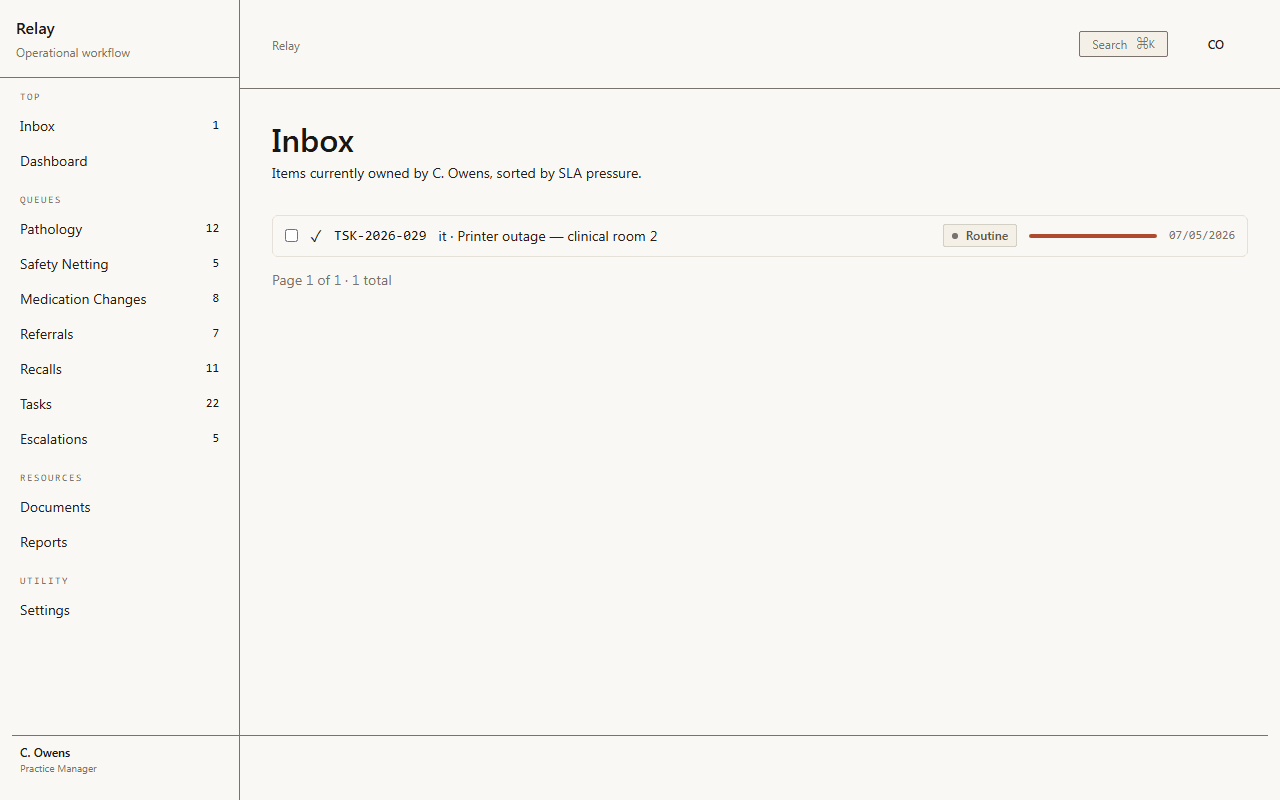
Relay inbox surface: left sidebar shows the six operational queues with live counts (Pathology 12, Safety Netting 5, Medication Changes 8, Referrals 7, Recalls 11, Tasks 22, Escalations 5); main panel shows the single inbox item owned by C. Owens — TSK-2026-029 Printer outage in clinical room 2, routine priority, due 07/05/2026.
Fig. 01 — Inbox. C. Owens's owned items, sorted by SLA pressure.
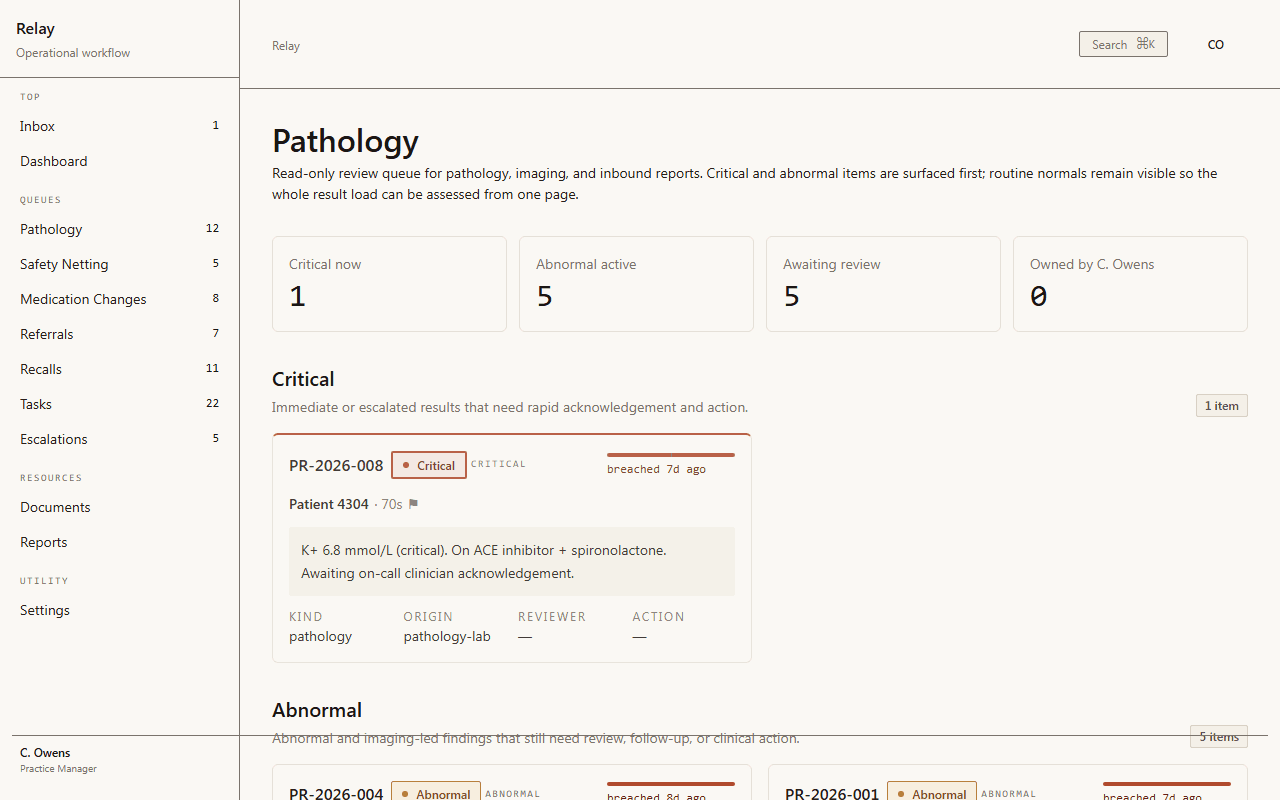
Relay pathology surface: four queue counters (Critical 1, Abnormal 5, Awaiting review 5, Owned by C. Owens 0); critical section shows PR-2026-008 — K+ 6.8 mmol/L on ACE inhibitor + spironolactone, awaiting on-call clinician acknowledgement, breached 7 days ago; abnormal section shows PR-2026-004 and PR-2026-001 below.
Fig. 02 — Pathology queue. Critical / abnormal / awaiting-review / owned surfaced at a glance, with the critical result inlined.
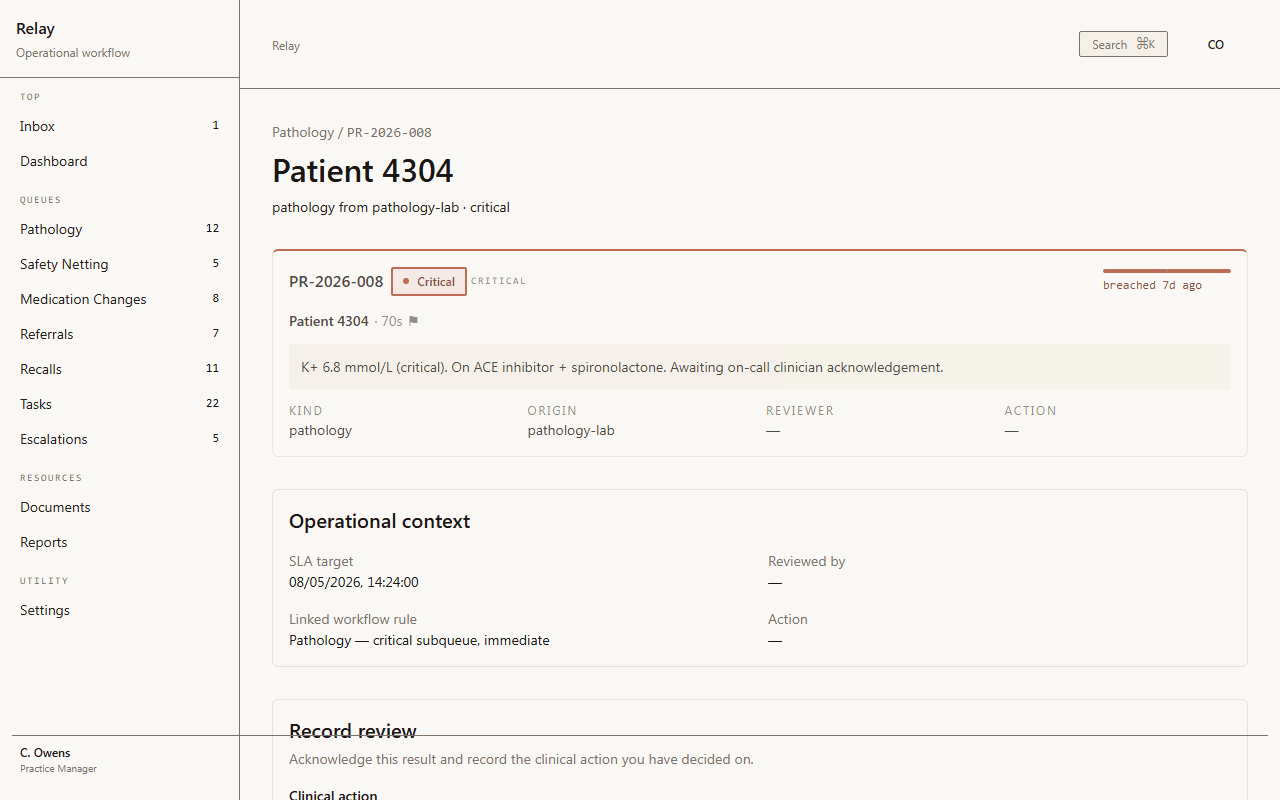
Relay pathology detail for PR-2026-008 (Patient 4304): the critical K+ 6.8 mmol/L result with kind / origin / reviewer / action metadata; operational context panel shows SLA target 08/05/2026 14:24:00, linked workflow rule (pathology — critical subqueue, immediate); Record review section prompts acknowledgement + clinical action.
Fig. 03 — Pathology detail. Single-record drill-down: operational context + record review prompts.
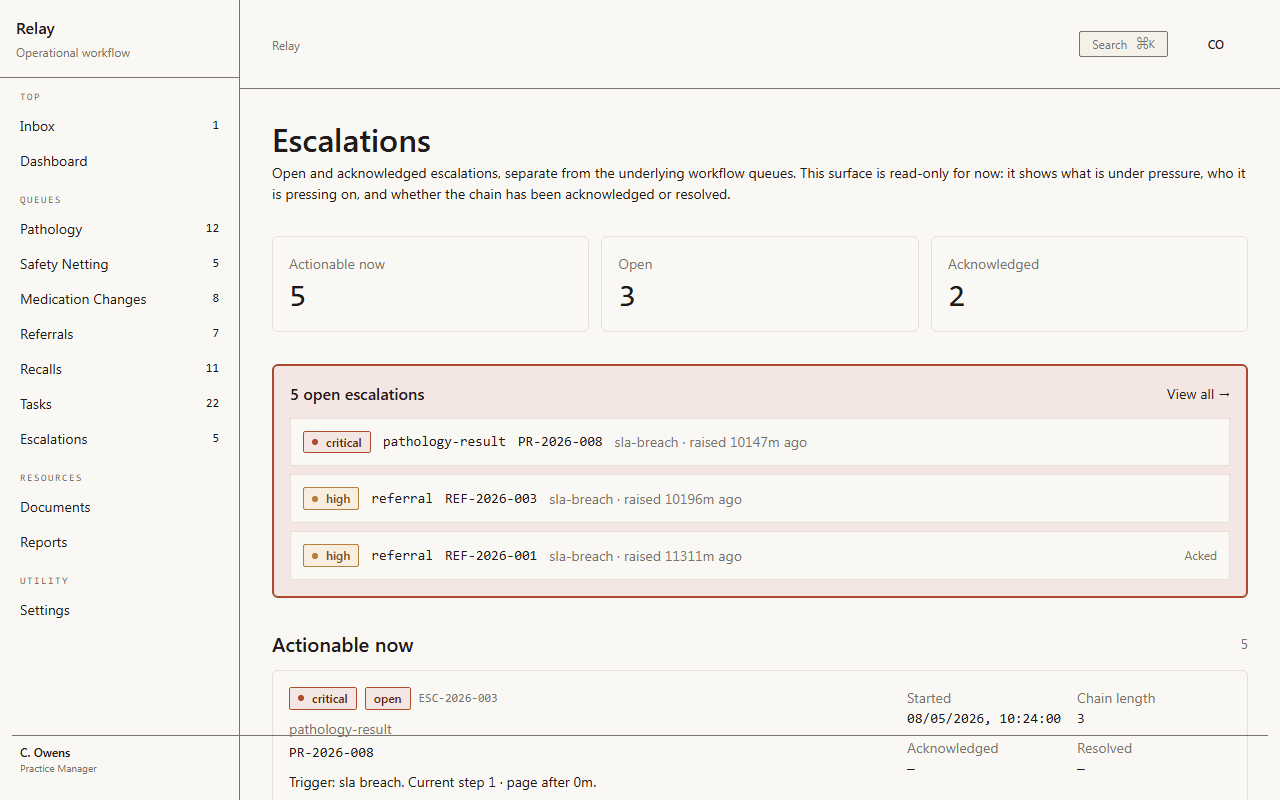
Relay escalations surface: 5 open escalations panel showing critical pathology PR-2026-008 (SLA breach, raised 10128m ago), high referrals REF-2026-003 and REF-2026-001 (REF-2026-001 acknowledged); below the actionable-now section shows ESC-2026-003 — critical pathology-result chain of length 3, currently at step 1.
Fig. 04 — Escalations. Pressure-routing surfacing what's breaching, chain length per escalation.
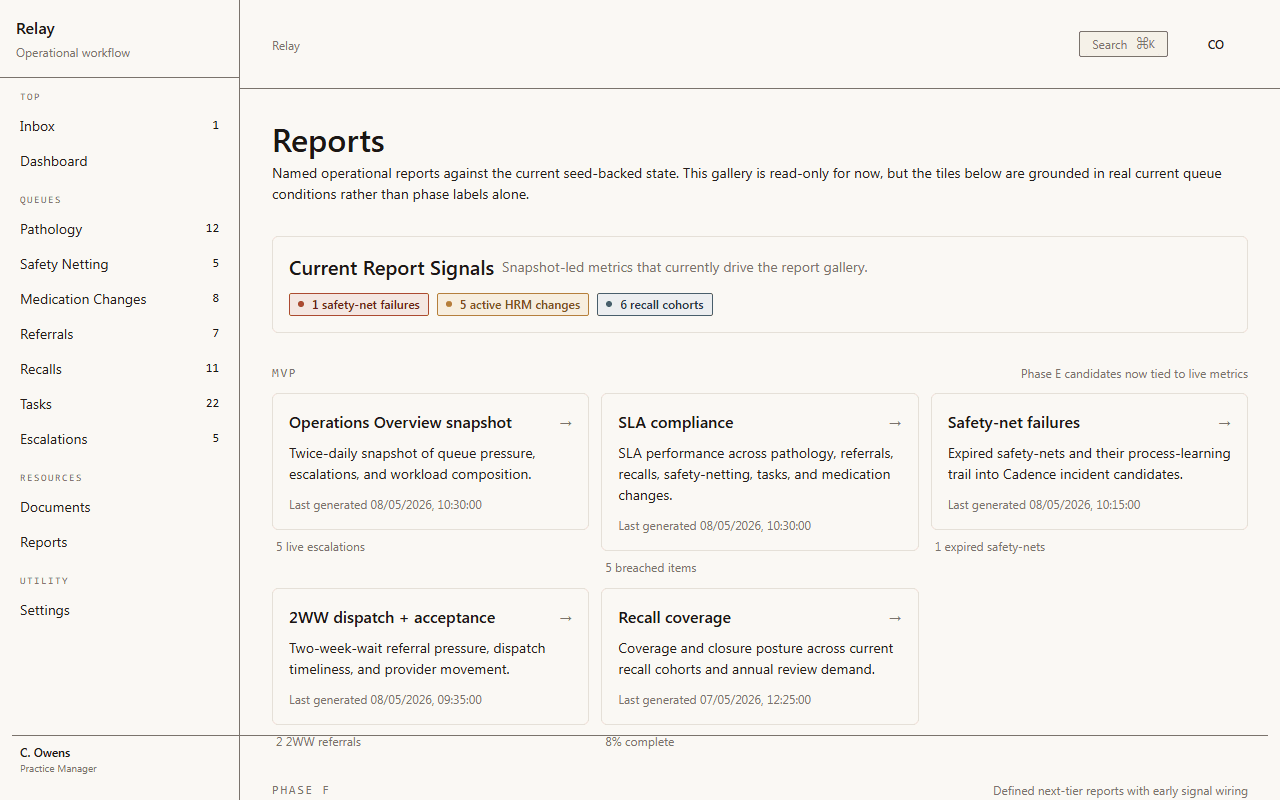
Relay reports gallery: Current Report Signals panel shows 1 safety-net failures, 5 active HRM changes, 6 recall cohorts; MVP tier reports (Operations Overview snapshot, SLA compliance, Safety-net failures, 2WW dispatch + acceptance, Recall coverage) each with last-generated timestamps and live counter metrics like 5 live escalations, 5 breached items, 1 expired safety-net, 2 2WW referrals, 8% complete.
Fig. 05 — Reports. Named operational reports grounded in live queue conditions, with last-generated timestamps + live signal counters.

E — Honest notes

Things worth saying explicitly.

Relay is not a clinical record system.

It does not hold patient-level clinical data. It holds the operational state of the work that surrounds the clinical record — who's handled what, what's slipping, what's escalated, what's been audited.

Relay is preview, not GA.

The engineering is verified; the partner-deployed experience is not yet. We accept early-access partners through the alpha application — onboarding is white-glove, and the feedback loop directly shapes what ships.

Relay does not eliminate the inbox.

It replaces the multi-spreadsheet shadow system that lives next to clinical inboxes. The clinical system is still where clinical decisions are recorded; Relay is where operational follow-through is tracked.

Audit-logged means transactional.

If the database transaction that changes operational state fails, the audit row does not get written either. There is no scenario where the audit log disagrees with the operational state. This is engineering discipline, not marketing language.

F — Access

Preview by application.

Relay — preview access

By application

Pricing follows partner-deployed validation.

  • · Founder-level support during preview
  • · Manual onboarding tailored to practice workflow
  • · Single-tenant deployment with isolated data
  • · Direct influence over the GA capture-flow set
  • · Preferential GA pricing when published
Preview partners commit to approximately two hours per month of feedback time across the first three months — a workflow walkthrough at month one, a queue-realism review at month two, an escalation calibration at month three.
Apply for early access

G — Common questions

Frequently asked.

How does Relay relate to Cadence?
Cadence is governance — risks, significant events, complaints, audits, decisions, evidence. Relay is daily operations — the queues that fill up before any of that becomes a governance item. Together they cover the operational and governance work most practices run as two separate spreadsheet stacks. They share visual grammar and tenancy discipline; they are deliberately not feature-coupled or schema-coupled.
Is Relay available now?
Relay is preview status — engineering-verified (clean typecheck, build, 106/106 active drift-guard tests, six capture flows wired) but not yet partner-deployed. Interested partners can apply via the partnership form; early access is by application.
Does Relay integrate with EMIS / SystmOne?
Native clinical-system integration is post-general-availability. Relay runs alongside the clinical system — operational data, not patient data, is the substance of the system. The interface between Relay and the clinical record is the human in the loop, which is the right boundary while we learn what integration actually saves.
What does the transactional audit log do?
Every action — acknowledge a pathology result, dispatch a referral, close a safety-net — is wrapped in a database transaction that writes both the state change and an audit row atomically. Either both succeed, or neither does. The audit log is the institutional memory of who did what when, and it cannot diverge from the operational state.